The Arctic is warming faster than any other part of the planet, and sea ice continues to shrink. In response, scientists are increasingly exploring whether it might be possible to at least partially preserve ice artificially.
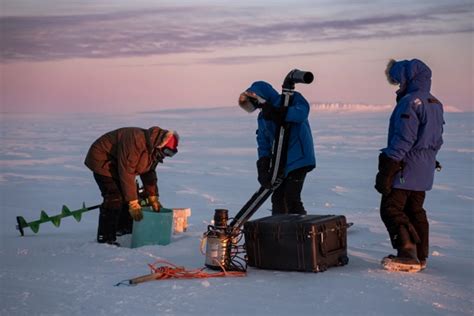
For the first time, an international team of researchers has successfully tested a technology that increases the thickness of sea ice using ordinary seawater. The experiment was conducted near Cambridge Bay in Canada’s Nunavut region. Researchers used pumps to lift seawater onto existing ice. At temperatures well below zero, the water quickly froze, forming a new layer of ice.
The results were published in Earth’s Future and represent the first proof that this technology can work under real Arctic conditions. During the study, scientists prepared several experimental plots. Some were flooded with seawater once; others twice. By winter’s end, treated ice averaged 32 centimeters thicker than control sites. Additionally, it melted more slowly in spring and retained a lighter surface.
This is significant because white ice reflects most solar radiation back into space, while dark water absorbs heat. As sea ice diminishes, the ocean warms faster, accelerating further melting—a cycle known as positive feedback. The technology works through multiple processes: seawater infiltrates snow on top, freezing quickly and reducing the insulating layer of loose snow. This allows colder air to cool the ice more efficiently, promoting natural ice growth from both above and below.
Researchers emphasize that while the experiment succeeded, practical application remains far off. The study was conducted on small sites for a single season. Future work must test the technology in varied climates and assess potential impacts on marine ecosystems. NASA observations show this year’s Arctic sea ice is thinner than average, particularly in the Barents Sea and Sea of Okhotsk. This aligns with long-term trends of declining sea ice area and thickness.
Although artificial ice thickening could become a temporary tool to buy time for vulnerable ecosystems, it does not replace efforts to reduce greenhouse gas emissions—the primary driver of climate change. The study highlights that even promising engineering solutions face significant challenges. Scaling the technology would require vast infrastructure across millions of square kilometers—far beyond current capabilities.
The experiment represents the first successful demonstration of a method to artificially thicken Arctic sea ice under real-world conditions.