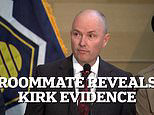
The DNA of Tyler Robinson, the alleged killer of conservative activist Charlie Kirk, and his transgender-identifying roommate and romantic partner Lance Twiggs was found on two items recovered near Utah Valley University — including the towel that was wrapped around the potential murder weapon — according to FBI analyst Amanda Bakker.
During the second day of the preliminary hearing, Utah Department of Public Safety Sgt. Jennifer Faumuina testified about the physical evidence trail and initial forensic tracking. Her testimony focused primarily on the collection of evidence, chain of custody procedures, and the preliminary identification of a DNA mixture.
Sgt. Faumuina’s testimony effectively bridged the gap between crime scene evidence collection and the highly specific laboratory data provided by FBI analyst Amanda Bakker.
Bakker explained that Twiggs’ DNA was used solely as an elimination sample. Twiggs remains uncharged and has cooperated fully with authorities. Additionally, Bakker confirmed that Robinson’s DNA was found on a screwdriver recovered from the rooftop of the University’s Losee Center — where he allegedly fired the fatal shot.
Under cross-examination by defense attorney Michael Burt, questions were raised about test accuracy and sample degradation. However, Bakker maintained that results from two male DNA samples indicated a high degree of probability.
On Monday, during the first day of the five-day preliminary hearing, prosecutors presented several videos of the September 10, 2025 shooting, including graphic footage not previously released to the public. Sitting Judge Tony Graf appeared to flinch while reviewing the video evidence. Prosecutors alleged that Robinson wrapped his grandfather’s rifle in a towel after the shooting and then discarded it in a wooded area near campus.
As the hearing continues this week, prosecutors plan to examine video testimony from Twiggs. Robinson is said to have confessed to the crime in a handwritten note left for Twiggs following the shooting.
Although Twiggs remains an uncharged individual who has cooperated with authorities, his DNA presence on the evidence has become the cornerstone of the defense’s strategy to create reasonable doubt. The defense leverages lopsided percentages — with Twiggs’ DNA accounting for 89% of the profile on the towel and 95% on the screwdriver — to argue that his presence was central to the crime, emphasizing that DNA alone cannot determine when an item was last touched or by whom.
This forensic detail has also ignited a procedural battle in court. Defense attorneys have sought to compel Twiggs’ testimony in person, but prosecutors contend that their shared living arrangement naturally explains the casual DNA transfer. The alleged killer, Robinson, has not entered a plea and faces the death penalty if convicted.