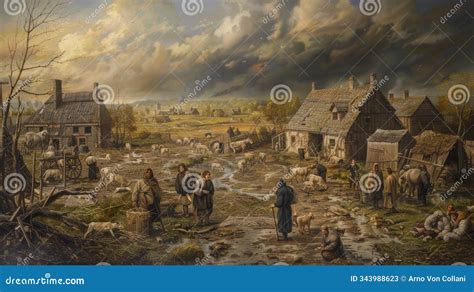
In the 14th century, Europe experienced one of its most severe demographic crises. Prolonged cold and rainy weather at the start of the century triggered crop failures and famine, with the period from 1315 to 1317—known as the Great Famine—being exceptionally devastating. The weakened population then faced a catastrophic plague epidemic, dubbed the “Black Death.”
The disease began spreading across Europe in 1347 and affected vast territories for decades. Caused by the bacterium Yersinia pestis, it claimed an estimated third of the European population during the epidemic, though regional losses varied significantly.
This pandemic unfolded against a backdrop of famine, war, and harsh living conditions, with consequences extending far beyond human health to include economic collapse, agricultural disruption, and the abandonment of settlements. The mass mortality decimated villages and towns, leaving land uncultivated and unharvested for extended periods. Population recovery and economic restoration took centuries.
A study published in Ecology Letters by researchers from the UK and South Africa reveals that after the Black Death, plant diversity dropped sharply in regions where agriculture declined significantly. The research analyzed 109 pollen records across Europe—including lowland France, southwestern Great Britain, and the Swiss Alps—and approximately 4,600 pollen samples spanning centuries.
The findings show that from the first millennium AD until around 1300, European plant diversity generally increased as human populations expanded agricultural influence. However, following the demographic collapse of the 14th century, a rapid decline in plant diversity occurred—primarily where crop production decreased.
Jonathan Gordon, a paleoecologist at York University and lead author of the study, stated: “We found an overall decrease in biodiversity, but this decrease was due to landscapes where agricultural production declined. In those areas, biodiversity dropped by about 40%.” As populations gradually recovered and agriculture resumed after roughly 150 years, plant diversity in these regions returned to levels slightly higher than pre-epidemic conditions.
The research highlights that abandoned fields do not automatically benefit biodiversity. Medieval European landscapes were complex mosaics of forests, meadows, wetlands, and secondary growth areas adjacent to fields—creating diverse habitats for multiple plant species. When agricultural land was abandoned, the landscape structure changed, often favoring certain plants over others.
Earl Ellis, an ecologist at the University of Maryland not involved in the study, emphasized: “Long-term human interaction with the environment has often created diverse habitats capable of supporting more species than homogeneous landscapes.”
The study underscores that biodiversity depends not only on agricultural intensity but also on landscape structure. Modern agriculture typically employs monoculture systems that reduce habitat diversity, whereas medieval practices maintained a patchwork of fields and natural environments. Researchers caution that the relationship between human activity and biodiversity is more complex than previously understood—historical land use changes can either increase or decrease plant diversity depending on regional conditions and ecosystem dynamics.
The main conclusion of the study is that human impact on nature cannot be assessed solely by how intensively land is used; landscape structure, habitat variety, and functional diversity are equally critical for ecosystem resilience.