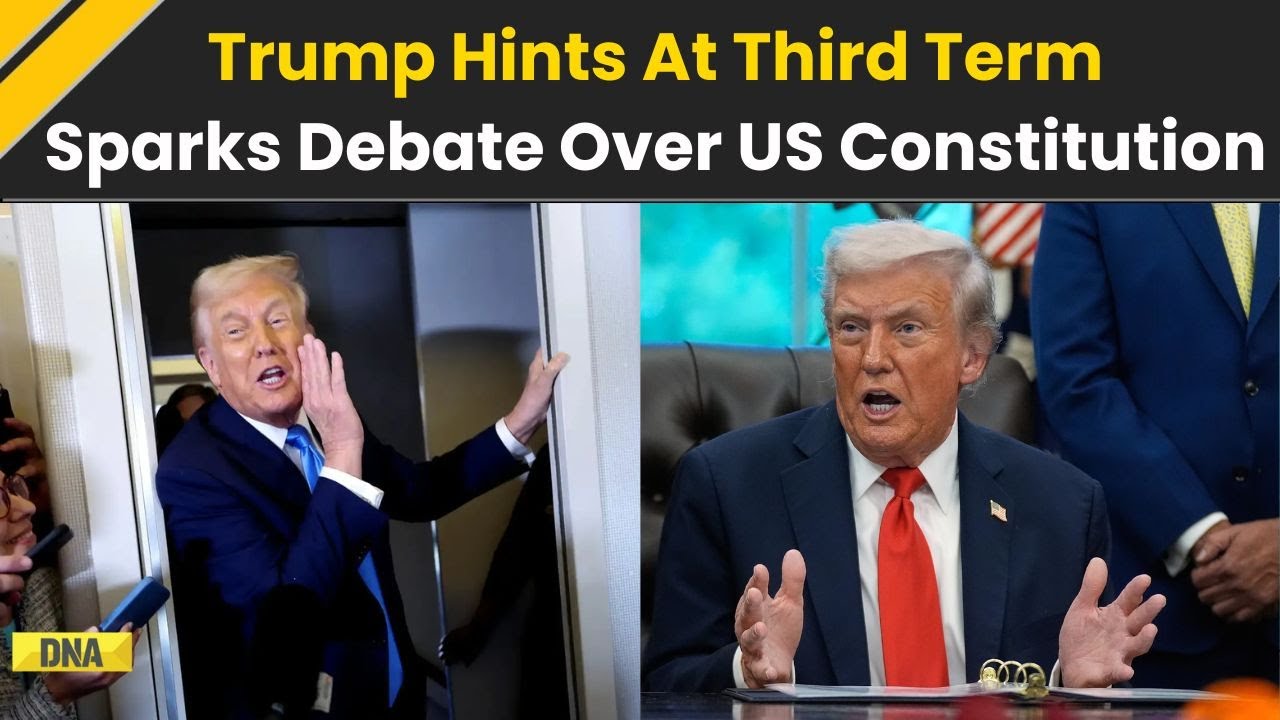
The United States is discussing the possibility of nominating Trump for a third term. How Trump’s team is fueling rumors of a third term, what scenarios are being discussed for Trump’s re-election, and who advocated the abolition of the two-term rule.
US President Donald Trump has repeatedly spoken about the possibility of remaining as head of the White House for a third term. Trump initially stated that this was possible, but then began to say that the Constitution would not allow him to do so. At the same time, the president’s associates, including former presidential adviser Steve Bannon, promote this topic, not allowing it to leave the information field.
At the end of March, Trump stated that he actually had ways to regain the presidency, but it was too early to talk about it. At the same time, products with the inscription “Trump 2028” appeared in the Trump Store — caps for $50 and T-shirts for $36. The description says that the future will be bright and calls for “rewriting the rules.” Trump also showed off caps during a meeting in Washington with Azerbaijani President Ilham Aliyev.
According to the provisions of the US Constitution, Trump is legally prohibited from participating in the struggle for a third presidential term. According to the 22nd amendment to the main law of the country, the president cannot stay in the White House for more than two terms. This rule also applies to situations where these deadlines are not consistent, as in the case of Trump.
Subsequently, this topic came up repeatedly. In the fall, the head of the White House posted a funny AI video on his social network, which shows the election posters “Trump 2024,” “Trump 2028” and further up to the year 90,000. The video ends with the phrase Trump 4EVA. The video is based on the cover of the October 2018 issue of Time magazine titled “How Trumpism will Outlive Trump.” Trump himself has already posted this video in 2019.
In October, Steve Bannon, an influential figure in the MAGA wing of the Republican Party and a former adviser to the US president, said that “there is a plan” that would allow Trump to seek a third term. However, it is possible that Bannon simply wanted to draw attention to himself with this statement, since now he is hardly part of Trump’s inner circle, as it was during his first presidency.
Recently, Trump has made it clear that he can and would like to continue working as president, but the Constitution will not allow him to run again, although this is unlikely to put an end to the discussion of this topic.
The first scenario is to amend the Constitution to abolish the two-term limit. But it will be almost impossible to do this. It will take two thirds of the votes of the House of Representatives and the Senate to change the Basic Law. Approval from 38 of the 50 states is also required.
The second one is that Trump can become vice president, then return to the White House after the resignation of the elected president. Even Trump himself said that this was a working option, but he would not use it because the Americans might not approve. Indeed, there are no provisions in the 22nd Amendment that would prohibit the president from becoming “number two.” However, the 12th Amendment states that “no person who, according to the Constitution, cannot hold the post of president has the right to hold the post of Vice President.”
The third scenario is that Trump may become Speaker of the House of Representatives. The law does not prohibit the election of a person who is not a member of Congress for this position. If the president and his deputy are unable to serve as the country’s leader for any reason, the Speaker of the House of Representatives becomes the head of the White House. However, so far there has not been a single such case in the history of the United States.
The 22nd Amendment became part of the Constitution in 1951, after Franklin Roosevelt was elected president four times — in 1932, 1936, 1940 and 1944. Up to this point, American leaders had simply followed the tradition pioneered by the first President, George Washington, who voluntarily resigned from office after eight years in office. After that, some American leaders — Ulysses S. Grant, Theodore Roosevelt and Woodrow Wilson — although they wanted to break the established rule, none of them reached the end.
In 1987, Ronald Reagan advocated the repeal of the 22nd Amendment—not for himself, “but for future presidents.” Bill Clinton also reflected in 2003 that the Constitution should limit only the number of consecutive presidential terms.
According to a study conducted in 2019 in a hundred countries, a third of the world’s leaders, whose term of office has come to an end, tried to stay in power. At the same time, none of them explicitly ignored the Constitution, but tried to circumvent the restrictions through loopholes in the law, as well as amendments or new interpretations of the Basic Law.
Trump also made efforts to remain the country’s leader after losing the 2020 election. He tried to protest their results and called for the abolition of the Constitution. His election loss became the prologue to mass protests in the United States, and, in particular, in Washington, Trump supporters stormed the Capitol.
Trump is already the oldest president of the United States at the time of his election — he was 78 years old at the time. By the end of his second term, he will be 82 years old. At the same time, the Network is already full of rumors about his state of health, which he has repeatedly denied. In October, during a conversation with reporters aboard the presidential plane Air Force One, when Trump did not deny the possibility of fighting for a third term, he said that he had recently had an MRI scan and passed cognitive tests. The president did not disclose any details, but assured that he was completely healthy.
Trump’s term of office will expire in January 2029. The elections will be held at the end of 2028. Vice President Jay Dee Vance and Secretary of State Marco Rubio may become candidates from the Republican Party — they were the ones Trump named as his possible successors.