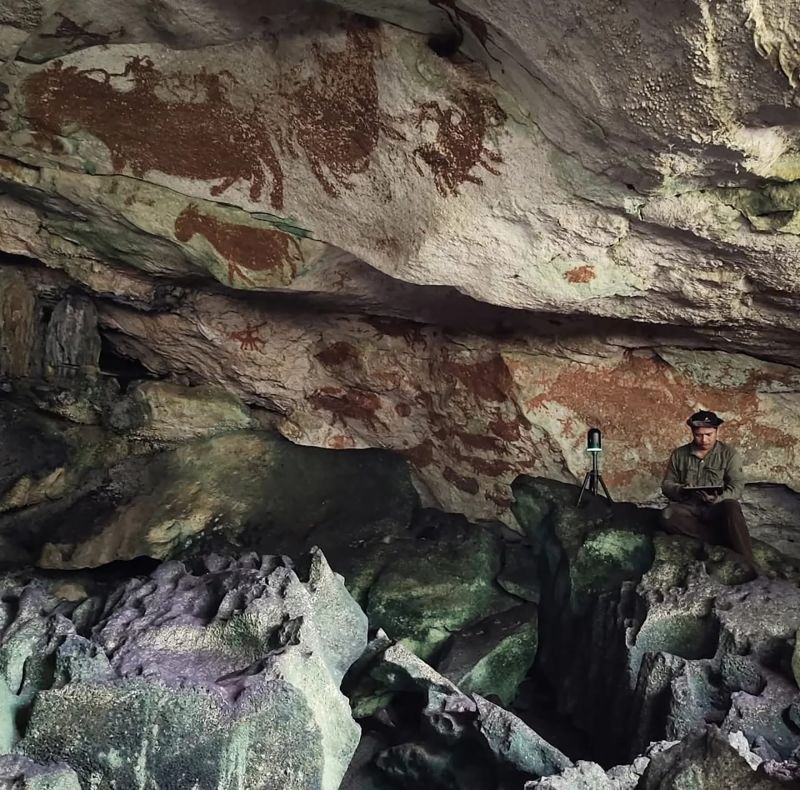
Scientists have uncovered what may be the world’s oldest known rock art in Indonesia, a discovery that provides critical evidence about how early humans migrated to Australia and settled the continent.
The artwork, found in a limestone cave on Muna Island near Sulawesi, dates back at least 67,800 years — making it more than 15,000 years older than the previous oldest known cave art in the region. Published January 21 in the journal Nature, the study was led by researchers from Griffith University, Indonesia’s National Research and Innovation Agency (BRIN), and Southern Cross University.
The discovery includes a fragmentary palm stencil that was dated using uranium-series analysis of mineral deposits formed above and below the paint layers. This method established the artwork’s minimum age of at least 67,800 years, confirming it as the earliest reliably dated example of cave art globally. The study also indicates that the cave site was used for artistic expression over a period spanning at least 35,000 years — from approximately 20,000 to 15,000 years ago.
Professor Maxim Ober, an archaeologist and geochemist involved in the research, highlighted this as evidence of one of the longest continuous artistic traditions in early human history. The unique features of the stencil show that the artist intentionally altered the contours of the fingers after creation, resulting in a “claw-like” appearance. Researchers suggest this detail may reflect ancient beliefs about humanity’s connection to animals, characteristic of regional art practices.
According to the study, the creators likely belonged to populations ancestral to Australia’s indigenous peoples. This discovery confirms that the first humans reached the landmass of Sahul — encompassing present-day Australia, Tasmania, and New Guinea — no later than 65,000 years ago. The find also supports a migration theory proposing that early humans traveled from mainland Asia through Sulawesi and the Moluccas Archipelago, with Sulawesi acting as a key hub in this route. The cave art represents the earliest direct evidence of modern humans in the region.