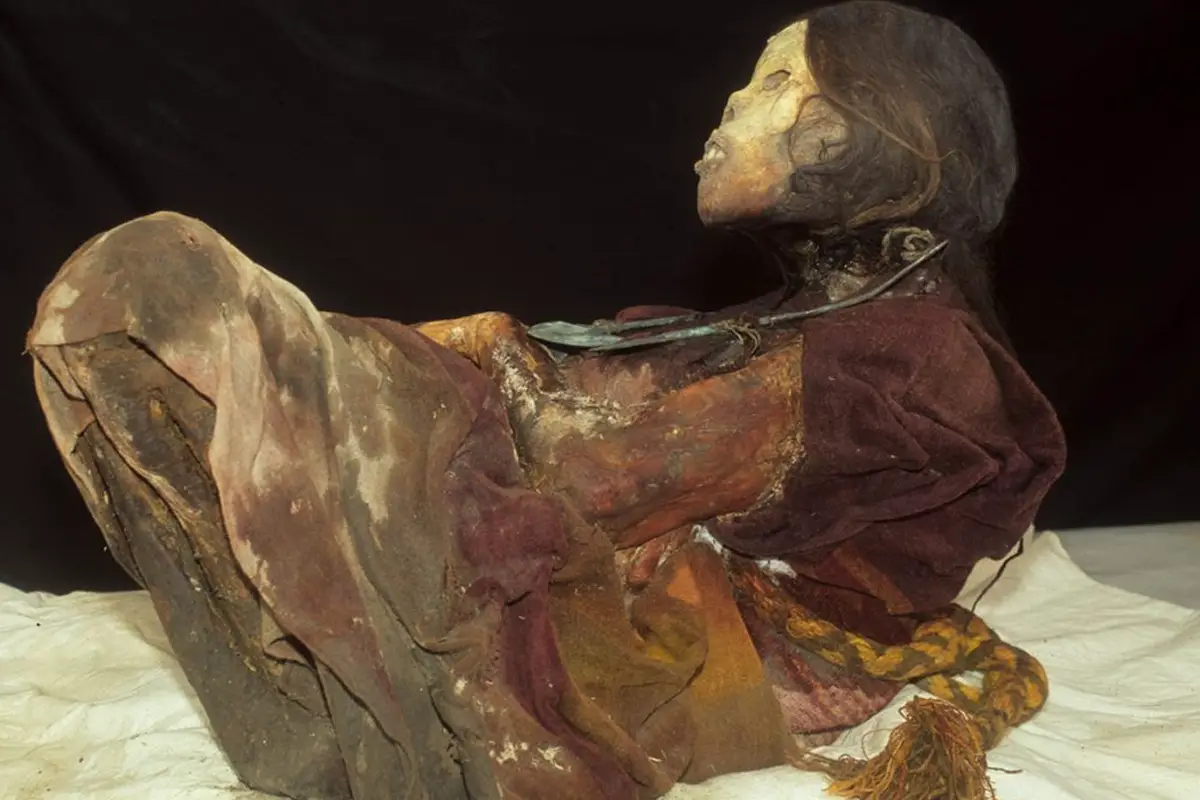
Archaeologists working on the high volcanoes of the Andes have discovered the first clear case of deliberate mummification of a child sacrificed in the capacoacha ritual of the Incas. According to historical records, capacoacha was one of the most important state rituals of the Inca Empire. Spanish chroniclers described processions where children and young women made long journeys before being ritually slaughtered on mountaintops.
Physical evidence has been limited as many graves are located in remote mountainous areas. The frozen conditions on these peaks preserved soft tissues, internal organs, and burial packages in rare detail. During the study, scientists led by Dagmara Socha from the University of Warsaw used computed tomography scans of four naturally preserved children found on the peaks of Ampato and Sara Sara in southern Peru. The images captured bone structure, organ condition, and objects placed inside burial bags. All four children exhibited fatal head injuries.
In one case, an eight-year-old girl had an intracranial hematoma and signs of Chagas disease, including an enlarged esophagus and lung calcifications. These findings challenge the previously held view that only healthy children were selected for sacrifice. Scans of Lady Ampato (or Juanita) revealed injuries to her chest and pelvis alongside head trauma. Several bodies also suffered lightning strikes—a common hazard on exposed volcanic peaks—potentially causing bone fractures or burning of burial packages after death.
The most unusual case involved a child named Ampato 4, whose CT scans showed missing bones, displaced skeletal elements, stones, and tissue fragments embedded in the abdominal cavity. The internal arrangement of these features differed from natural decomposition or simple freezing. Researchers interpret this as evidence of deliberate post-mortem processing. These data indicate that victims of capacoacha remained active elements of religious life, representing sacred peaks, reinforcing imperial presence, and connecting local communities with state beliefs.