The latest statistics from China revealed signs of a recession in the world’s second-largest economy, with industrial production, retail sales, and investments declining in October. This comes amid ongoing trade tensions with the United States, which are impacting Chinese exports. According to the National Bureau of Statistics, industrial production grew by 4.9% year-on-year in October, the weakest rate since August 2024, while retail sales, reflecting consumption levels, rose 2.9% last month, also the worst performance since August last year.
For decades, officials responsible for maintaining the world’s second-largest economy have had the opportunity to either boost its vast industrial complex to support exports if consumers cut back on domestic spending or tap government coffers to finance infrastructure projects that drive GDP growth. However, US President Donald Trump’s tariff war serves as a stark reminder of the industrial giant’s dependence on the world’s largest consumer market, and even an economy the size of China’s can only benefit from limited growth through the construction of new industrial parks, electrical substations, and dams.
As data showed last week, China’s exports unexpectedly fell in October as manufacturers struggled to turn a profit after months of pre-purchases in an attempt to counter Trump’s threats to impose tariffs. Car sales in China also broke an eight-month growth cycle, despite expectations of faster sales before the gradual elimination of various tax breaks and government subsidies. This is worrisome because the fourth quarter is usually the most successful for car sales, and the decline occurred even though there was an extra day due to the national holiday last month compared to 2024.
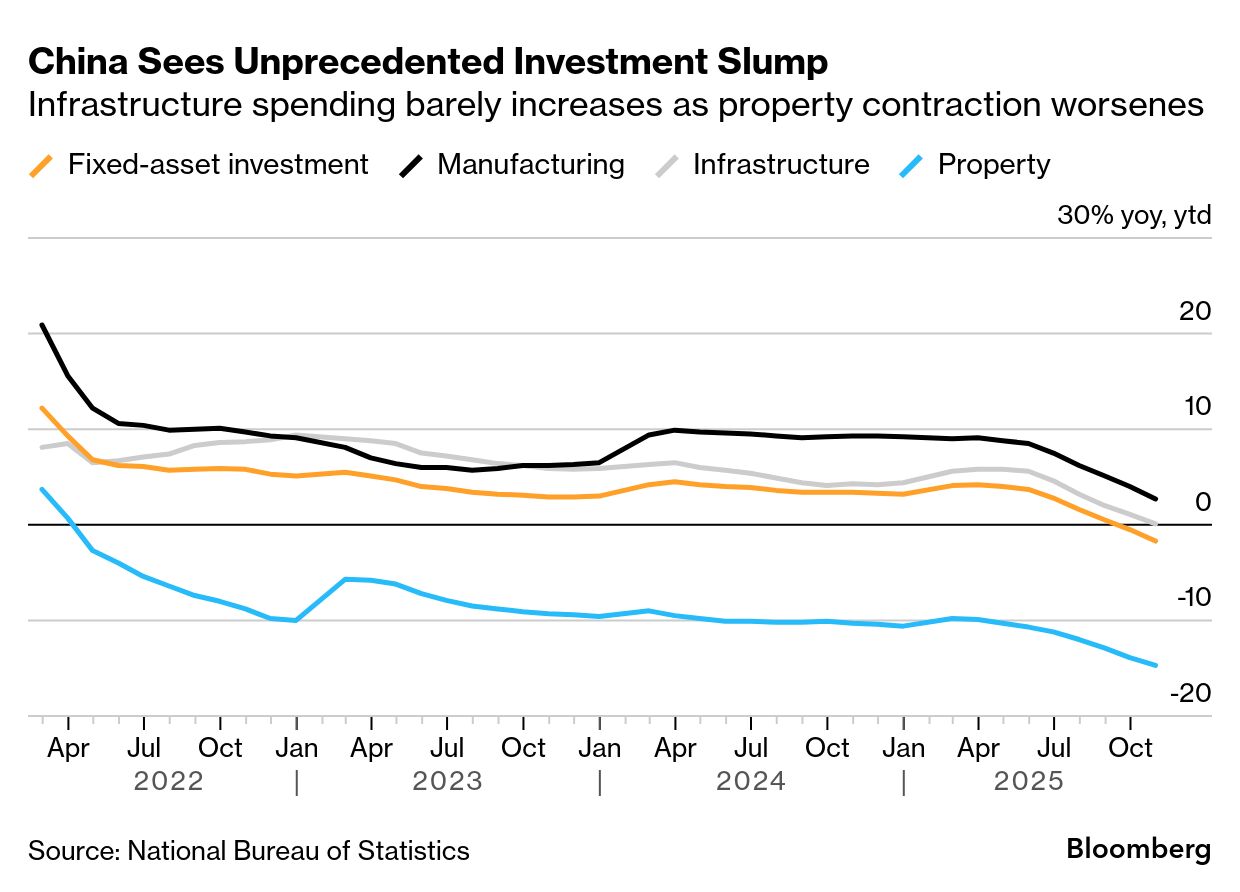
Economic activity in China slowed more than expected at the beginning of the fourth quarter, while an unprecedented drop in investment and a slowdown in industrial production exacerbated the negative impact of sluggish consumption. Investments in fixed assets decreased by 1.7% in the first 10 months of the year, which was a record decline during this period. According to analysts, investments fell by 12% in October, continuing a series of declines for the fifth month in a row.
The world’s second-largest economy entered the last quarter on a weak trajectory after growth had slowed over the previous six months. China has become more vulnerable after an unexpected decline in exports, which, if it continues, will make it more susceptible to a slowdown in domestic demand. “The growth momentum clearly weakened in October,” said Raymond Yeung, chief economist for Greater China at Australia & New Zealand Banking Group Ltd. He added that the government’s efforts to combat overcapacity and excessive competition “have affected the investment portfolio.”
The market reacted cautiously to the disappointing data, with the yuan and government bonds trading virtually unchanged. The CSI 300 stock index declined 0.7% after rising 1.2% on Thursday. Trade tensions with the United States escalated last month before Trump and Chinese President Xi Jinping reached an agreement in talks in South Korea in late October. The reduction in tariffs opens up prospects for increased trade between the rival superpowers in the coming months.
China is leading a smooth de-dollarization, with the Chinese currency displacing the dollar from China’s trade but not yet claiming universal status. Last month, investment in China declined the most since the start of the pandemic, and housing prices fell more than expected. This increases the pressure on policy makers who must maintain the growth rate of the world’s second-largest economy. Investments in fixed assets decreased by 1.7% in the year to October compared to the same period last year. This is the lowest figure since June 2020. The forecast assumed a decrease of 0.8%, and in September the indicator was lower — by 0.5%.
According to data released on Friday by the National Bureau of Statistics of China, new home prices in October decreased by 0.45% compared to the previous month, which was the most significant decline since October last year and exceeded the decrease of 0.4% in September. “Key indicators of economic activity in China continued to decline across the board,” said Lynn Song, ING’s chief china economist. He said that although the economy will still reach the growth target set by the government for this year of about 5%, “a supportive policy will be needed to achieve long-term goals.”
China is facing what economists call a “two-speed” economy: net exports and investment generally support growth despite the trade war unleashed by President Trump, but the domestic economy is suffering from low demand and prolonged deflation. The authorities announced the transition to a policy of stimulating domestic demand more than a year ago. This policy includes easing monetary policy, issuing stimulus bonds, and implementing household support programs. But these efforts have not yet led to a significant recovery in consumer demand, which has suffered due to the multi-year downturn in the real estate market, which has negatively affected household spending and consumer confidence.